
From an early seed grant to Nature: how the Brain Institute helped Fadok’s discovery happen
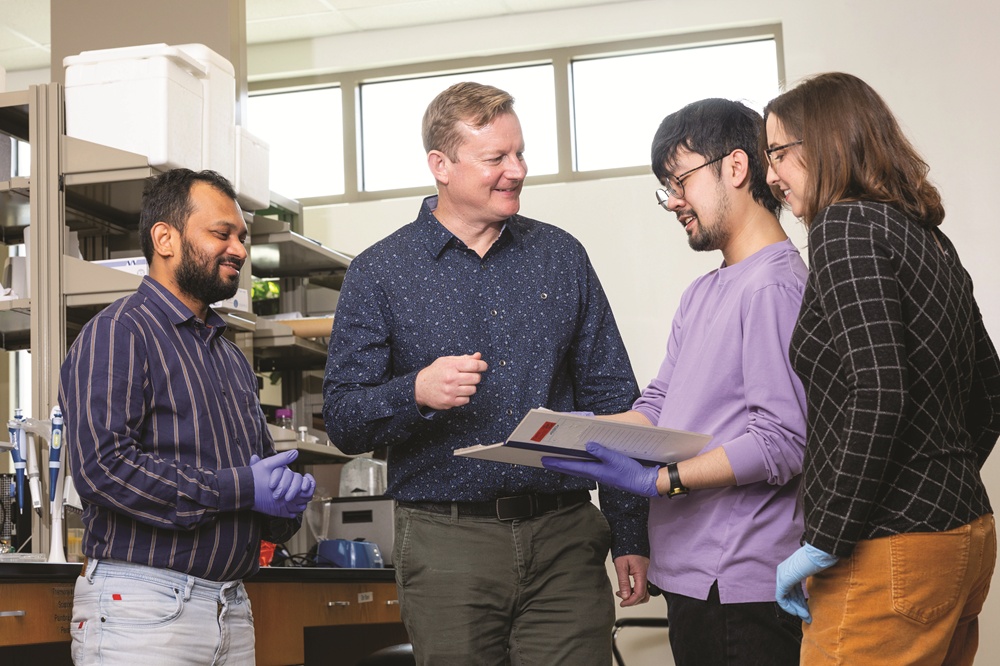
Photo by: Tulane University, Sabree Hill
Neuroscientist Jonathan Fadok’s groundbreaking discovery of a previously unknown brain pathway, published in Nature in 2024, could one day inform clinical treatments for PTSD, generalized anxiety disorder and other stress-related conditions affecting millions. The work was made possible by the Tulane Brain Institute, which provided Fadok with the early funding, facilities and collaborators that turned an idea into one of the field’s most significant findings on how mammals shift from freezing to flight when faced with a threat.
Fadok, the Burk-Kleinpeter, Inc. Professor in Science and Engineering, joined Tulane in 2017 as the first faculty member with laboratory space inside the Brain Institute. His office is named for Marta Marko’s mother, a recognition tracing directly to the founding gift Bill and Marta Marko made to launch the institute.
That gift also funded Fadok’s research at a critical moment.
“In 2018, I received the Marko Spark Award. I turned that data into an R01 proposal at the NIH, which was successful. That initial investment turned into millions of dollars.”
The Brain Institute’s interdisciplinary structure was equally consequential. Fadok partnered with Professor Ricardo Mostany, in the Department of Pharmacology, to implement calcium imaging, a technique allowing researchers to record activity from large numbers of brain cells simultaneously. As a behavioral neuroscientist, Fadok didn’t have that expertise.
“It’s something that requires an engineering approach. I’m not an engineer,” he said. “It’s been transformational for our lab’s research.”
Fadok takes seriously the Brain Institute’s mission to educate tomorrow’s neuroscientists. He mentors scholars in his lab and teaches Introduction to Brain and Behavior, an introduction to neuroscience. “I’m very passionate about teaching. I always incorporate neuroscience news, so the students see that there’s something about neuroscience in the news every day, and I tie content to their lives.”
Fadok also celebrates the Brain Institute’s recent investments, including a new MRI machine on the downtown campus that allows Tulane neuroscientists to image human brain activity. That, along with powerful algorithms for sorting through massive datasets, means that “it’s an exciting time to be a neuroscientist. With the technology explosion, we’re finally getting to the point where we can start to answer questions that were just too daunting before.”
