
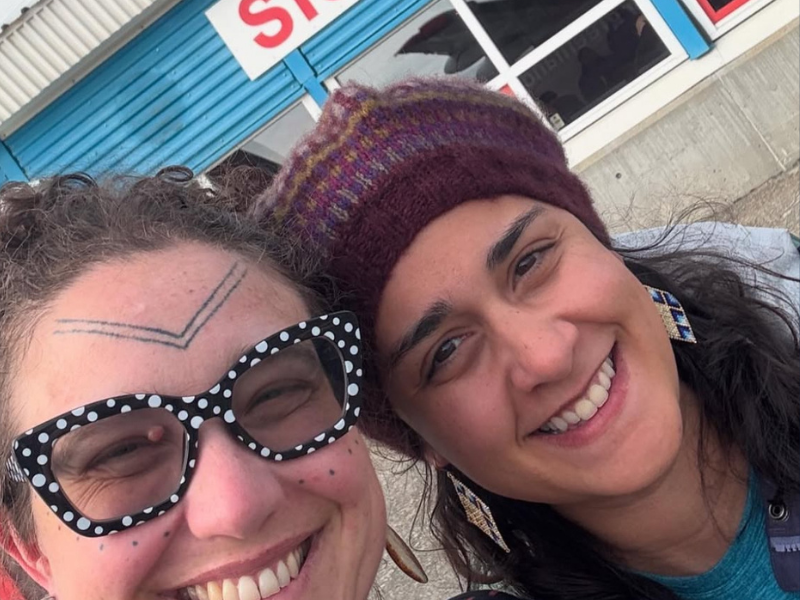
Mariah Seater (right) is getting on-the-ground training as part of the Fulbright Arctic Initiative. Pictured: Arriving in Sisimiut, Greenland with Dr. Heather Gordon as part of the cohort in-person gathering.
Tulane doctoral student Mariah Seater is participating in an academic exchange program that is both prestigious and deeply personal.
Seater, who is pursuing a doctorate in public health (DrPH) at the Celia Scott Weatherhead School of Public Health and Tropical Medicine, is one of 20 outstanding scholars taking part in the U.S. Department of State’s Fulbright Arctic Initiative.
Unlike other Fulbright programs, the Arctic Initiative spans 18 months and aims to strengthen the shared interests of Arctic nations in building a secure and sustainable region through collaborative, multidisciplinary research.
As a lifelong Alaskan with a passion for public health, Seater brings both personal insight and professional expertise to the program’s fourth cohort.
“There is a lot of good that can be produced out of Arctic research, and it transcends so many communities,” says Seater. “What happens in the Arctic doesn't stay there.”
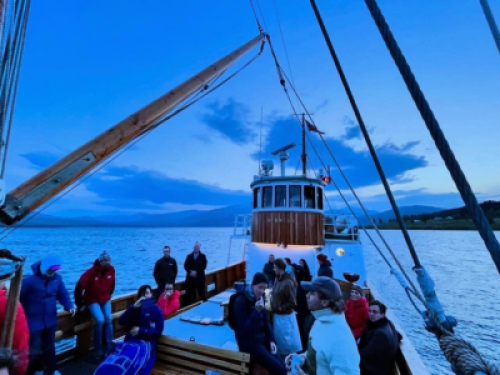
The program launched in September with a cohort trip to Norway, where participants observed regional issues and environmental conditions firsthand. The main objective soon followed: to develop research ideas and implement them in other Arctic contexts – essentially, taking a successful approach in one area and adapting it for another.
To facilitate progress, the cohort is divided into smaller working groups focused on specific topics.
These subgroups met again this month in Greenland and will reconvene next spring in Washington, D.C., where they will present their findings.
More fellowships fund global exploration
ALUMNA MAYA NEIBERG (BSPH ’25) wants to create meaningful change and improve human rights protections internationally. Now, thanks to the Eisenhower Global Scholars Program, this dream can become reality.
“I have always aspired to work in diplomacy and foreign policy, and now, with Eisenhower Fellowships’ support and international network, I will be better equipped to contribute to meaningful policy change and build cross-border collaborations that promote justice and accountability.” The program sends four American university graduates abroad for an academic year of postgraduate studies. Neiberg is now at IE University in Madrid to pursue a master’s degree in international relations.
Neiberg, originally from Carlisle, Penn., plans to spend her time broadening her understanding of international human rights. Her long-term goal is to improve accessibility to international legal mechanisms and ensure they serve not only governments but also the individuals and communities they are meant to protect.
Two other alumni, Tara Ivic-Pavlicic (BSPH ’20, EPI MPH ‘21) and public health minor Charlize Nguyen (’24), are among 12 Tulane students who have been named Fulbright grant recipients for 2025-2026.
Ivic-Pavlicic received an Open Study/Research Award in Serbia. She will be conducting lung cancer research at the University Clinical Center of Serbia in Belgrade. Serbia has some of the highest smoking and lung cancer rates in the world. Her project will be focused on determining how demographics, smoking exposure, sociocultural factors, and various treatment options are associated with survival among lung cancer patients.
Nguyen gained an Open Study/Research Award for Vietnam. She will be conducting public health research at the Oxford University Clinical Research Unit in Hanoi, Vietnam. The project will investigate the financial costs of improper antibiotic use—a common practice in Vietnam and a significant driver of antimicrobial resistance.
—Courtesy Newcomb-Tulane College
Seater’s group is addressing mental health and wellbeing in the Arctic, with a focus on land based healing and suicide prevention. She hopes to marry practices culled from partner violence prevention with Indigenous traditions to develop practical, culturally relevant program recommendations.
She pointed to an effective model against domestic violence from Iceland – adapted from a framework developed in San Diego -- called a family justice center. This model centralized services for victims of abuse, making it easier for them to get help by placing healthcare, legal and therapeutic professionals with other support resources in one location rather than scattered across a city or rural area.
“It doesn't have to happen again. If they can get everything they need and they're ready to make that transition … we have to catch them in that moment, because research says they'll try like three or four times before they actually leave the abuse,” Seater said. “So, if we make them do ALL these steps three or four times, we're just making it harder and then we're perpetuating these statistics that are horrifying. And that impact families, communities, productivity, the economy -- all the things.”
Seater questioned why similar programs hadn’t been implemented in other regions of the Arctic as robustly, even when high rates of interpersonal violence are present. The “one-stop” treatment model stuck with her as being particularly relevant within harsher climates and emerging natural disasters with dispersed populations – where access to multiple services may not be feasible.In addition to her Fulbright work, Seater was also selected by the National Academy for State Health Policy (NASHP) for an Emerging Leaders of Color (ELC) Fellowship in 2024. She credits the Fulbright program and Tulane with opening further opportunities, including being named polar scientist in residence for Arctic Basecamp, where she delivered presentations and research on the intersection of community health and interpersonal violence in the face of climate distress at events at the World Economic Forum in Davos, Switzerland.
To students considering a Fulbright, she encourages them to not let self-doubt prevent them from successfully applying.
“Don’t be intimidated by the process. I’m a working mom with three young children,” she says. “In my Fulbright Arctic group, there is every career stage – some doctoral students and early careers, some senior researchers and tenured professors, and some industry experts outside of academia. They are looking for creative thinkers and innovators who can lead change now and in the future.”
As for her current project, she is already seeing signs of impact.
“It's really exciting because we're already talking about where we can engage the community in this work across the different Arctic regions that we represent.”

All views and information presented in this article are representative of Mariah Seater and do not represent the Fulbright Program, the U.S. government, or any other government.
